
The six places a lead gets lost (and how to find yours in five minutes)
The Six Places a Lead Gets Lost in a B2B Funnel | Botmenia

Botmenia · Mahendra Sengar
Oct 22, 2026 · 12 min read
The Six Places a Lead Gets Lost in a B2B Funnel | Botmenia

Ask a founder how many leads they lost last month and you will get a number. Ask how many leads they never knew they had and you get a pause.
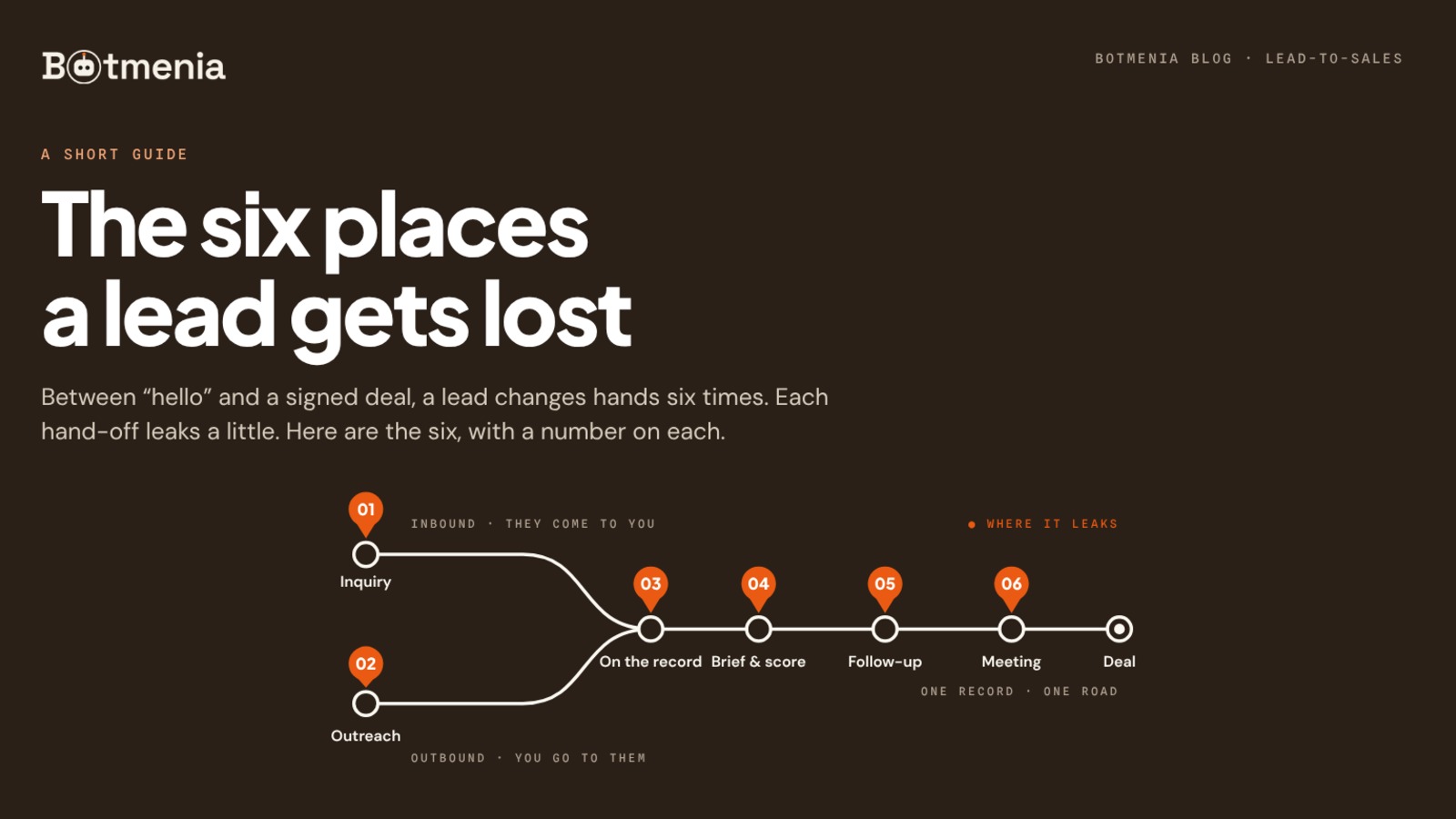
The pause is the point of this article. Between "hello" and a signed deal, a lead changes hands six times — from the channel it arrived on to the person who answers, from that person to the record, from the record to whoever researches it, follows it up, meets it, and writes up the meeting. Every hand-off leaks a little. None of the leaks show up in a report, because a lead that goes quiet does not say no. It just buys from whoever answered first.
This is a guide to those six hand-offs. For each one you get a plain description of what goes wrong, a number from published research (not our opinion), what it costs, and what it looks like when the hand-off runs on its own. At the end there is a five-minute self-check so you can find out which leak is yours.
It is written for founders and sales leads of growing businesses — the ones who get inquiries from a website, WhatsApp, email, calls or ads, and have a small team (or just themselves) handling every lead. If you have ever found a three-day-old message nobody answered, this is for you.
Leads enter a B2B funnel on two tracks. Inbound is the lead who comes to you with a question. Outbound is the lead you go to — a list, bought or built, worked cold. Both tracks meet at the record: the place where a lead becomes a lead. From there every lead takes the same road: briefed and scored, followed up, met, closed.
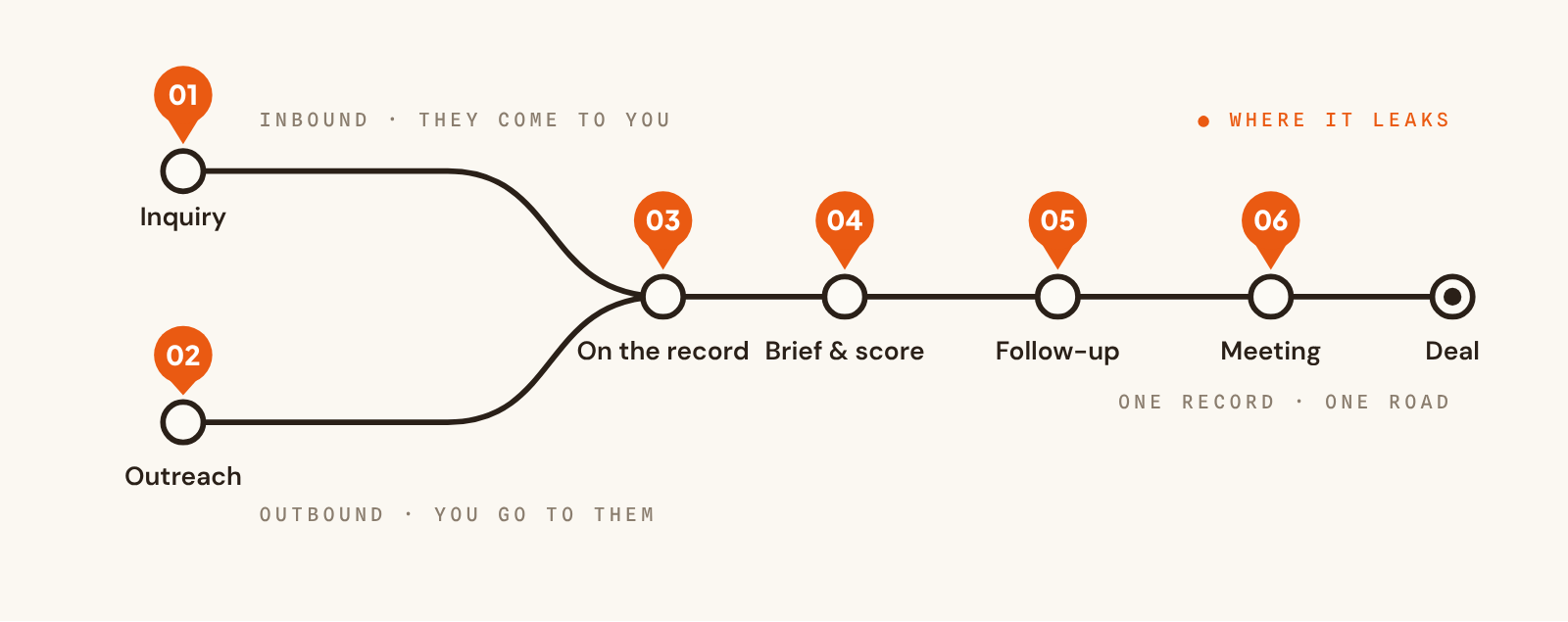
Put the hand-offs on one line and the pattern is obvious. Two leaks sit at the top, one on each track. One sits where the tracks meet. Three sit on the road to the deal. Here they are, in order.
Someone asked a real question at 9 pm. A person answered at 10 the next morning. By then the lead had asked two other companies the same thing.
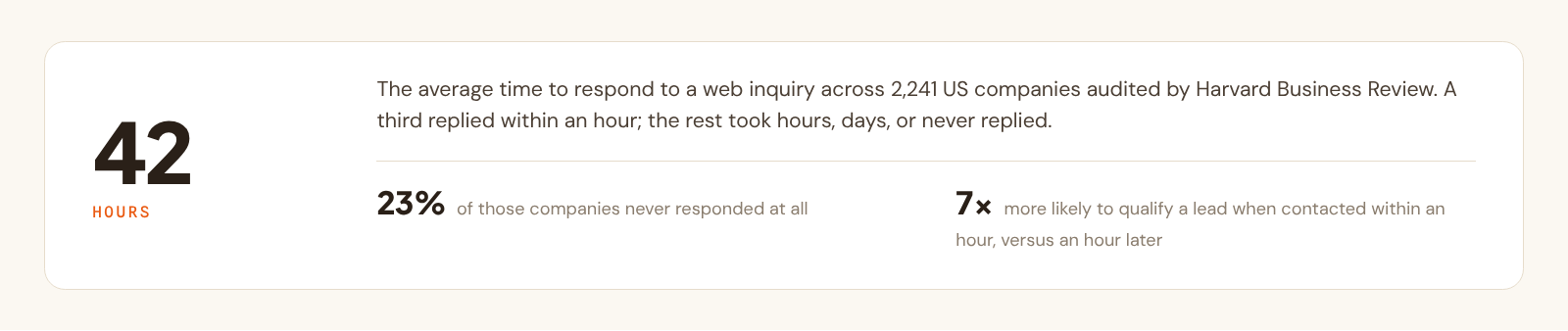
In 2011, Harvard Business Review audited 2,241 US companies by sending each a test inquiry through its own website and timing the reply. The average response took 42 hours. A third replied within an hour; 24% took more than 24 hours; 23% never replied at all. In the same research, companies that contacted a lead within an hour were about seven times as likely to qualify it as those that waited an hour longer — and more than sixty times as likely as those that waited a day or more.
A separate study of over 15,000 leads and 100,000 call attempts found the odds of qualifying a lead fall 21-fold when the first response slips from five minutes to thirty.
Why it happens. Inquiries arrive on every channel at once, and many arrive after hours. The person who could answer is in a meeting, driving, or asleep. The question sits in an inbox nobody owns until morning, when it competes with everything else.
What it costs. A slow reply rarely gets a "no". It gets silence — the lead buys from whoever answered first. Silence never shows up in a report, which is why this is the most expensive leak and the least noticed.
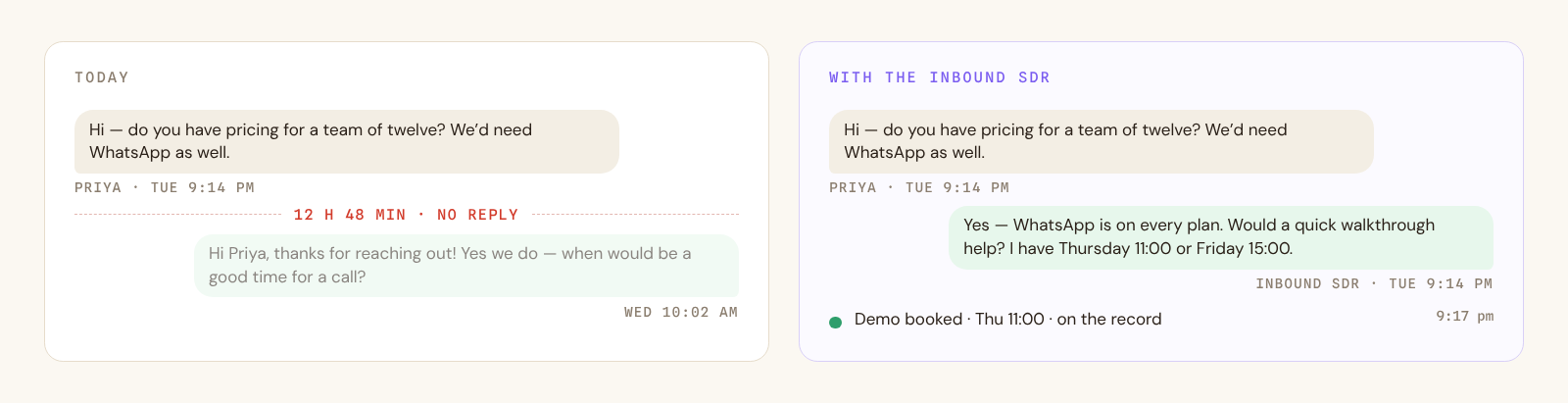
What closes it. An Inbound SDR agent answers on the channel the lead chose, the moment the question arrives — day or night. It qualifies in the conversation, books the meeting, and writes it on the record. It starts in approve-first mode, so a person sees every reply before it goes, until you trust it to run on its own.
Inbound is the lead who came to you. Outbound is the lead you go to. On a quiet Monday, sixty emails go out and three people reply. Then the week fills up, and the list sits for a fortnight — the three included.
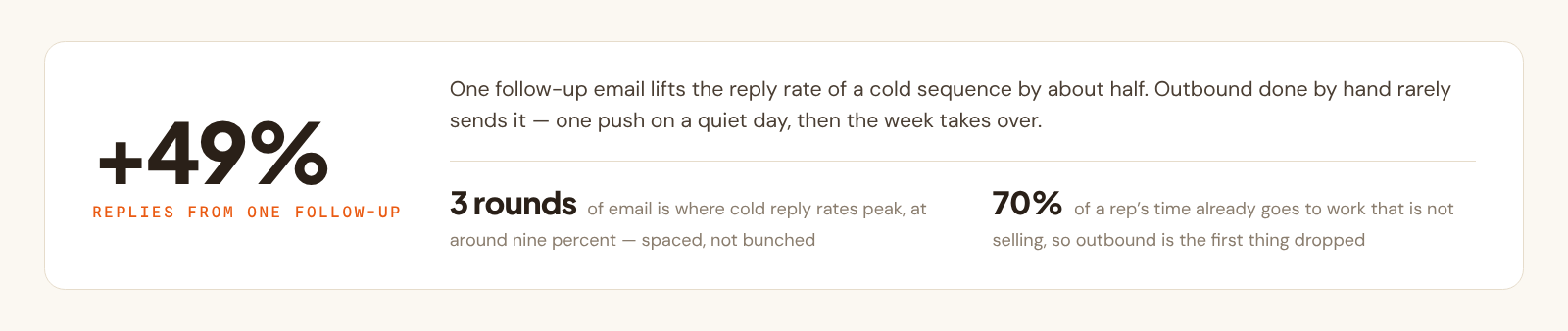
Cold-email benchmark data puts the lift from a single follow-up email at about 49%, and finds reply rates peak — at around nine percent — with three spaced rounds, not one. Outbound done by hand rarely gets to round two. Sales reps already report spending 70% of their time on work that is not selling, and outbound is the only activity with nobody waiting on it, so it is the first thing dropped in a busy week.
Why it happens. Outbound competes with everything else: inbound leads, meetings, customers. And a burst feels productive — sixty emails in a morning is a number you can report.
What it costs. The list goes cold between pushes, so every burst is a restart. Replies land on days nobody is watching. The three who said "tell me more" wait as long as the fifty-seven who said nothing — and after a week they are cold again.
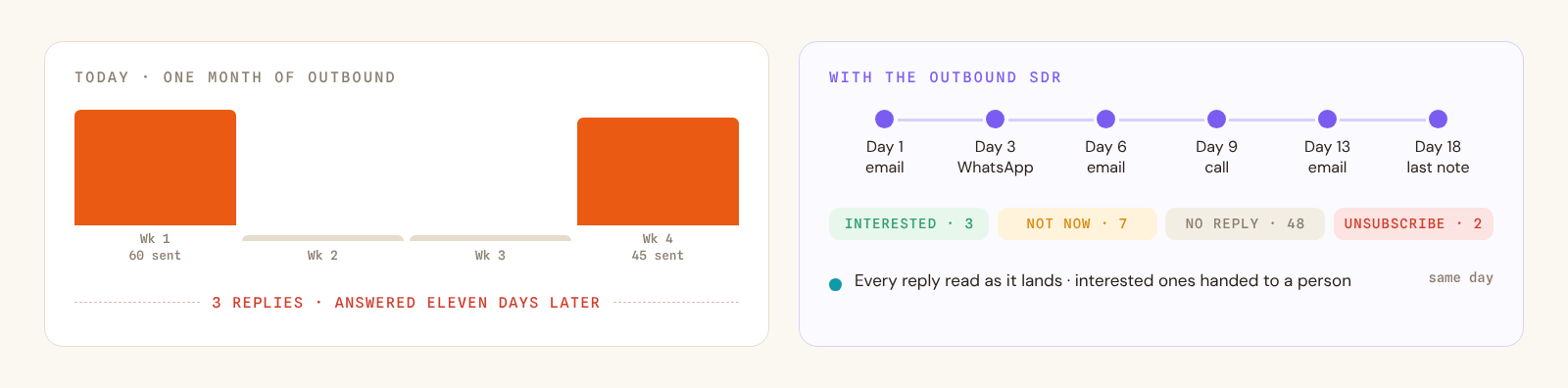
What closes it. An Outbound SDR agent writes a personal first touch for each name, runs a short sequence on the channels you allow, sends on schedule however busy the week is, and reads every reply as it lands — so the interested ones are talked to today.
Inbound or outbound, every lead has to be moved from where it surfaced — a chat, a form, an email, a reply — into wherever leads live. Some get typed in late. Some twice. Some never.
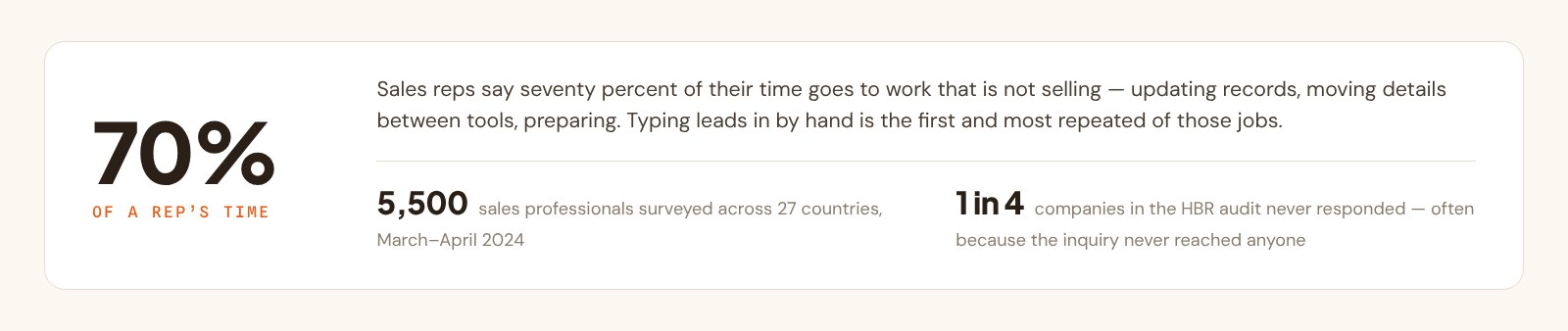
Salesforce's State of Sales survey of 5,500 sales professionals across 27 countries found reps spend seventy percent of their time on tasks that are not selling: updating records, moving details between tools, preparing. Typing leads in by hand is the first and most repeated of those jobs. And remember the HBR audit: one company in four never responded to a test inquiry at all — often because the inquiry never reached anyone.
Why it happens. Leads arrive in places never designed to hand them over: a WhatsApp thread on someone's phone, a form that emails one person, a comment under a post. Each needs a human to notice it, copy the details, and decide who owns it. When the human is busy, the lead waits where it landed.
What it costs. Duplicates make two people chase the same lead. Missing fields make the next person start from zero. And the inquiry that was never captured is not a lost lead in any report — it is simply absent, which is worse.
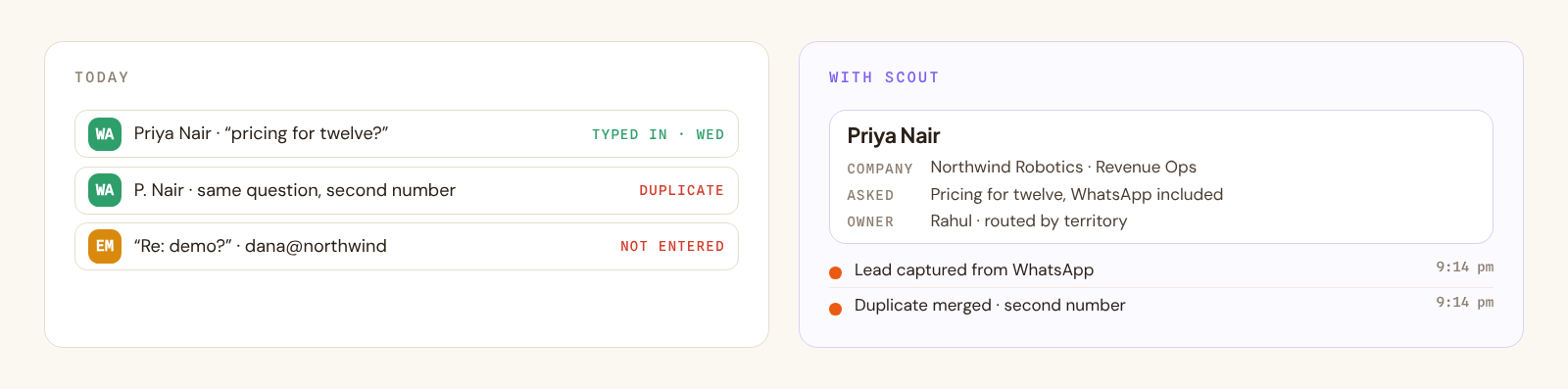
What closes it. A Scout agent reads every conversation and form, turns each inquiry into a lead on the record with the details filled in, merges duplicates, and routes it to the right owner. Nobody types a lead in again.
Before a good first call, somebody opens the company's website, LinkedIn, a funding database and the last email thread. Forty minutes later the call starts — or the research is skipped.
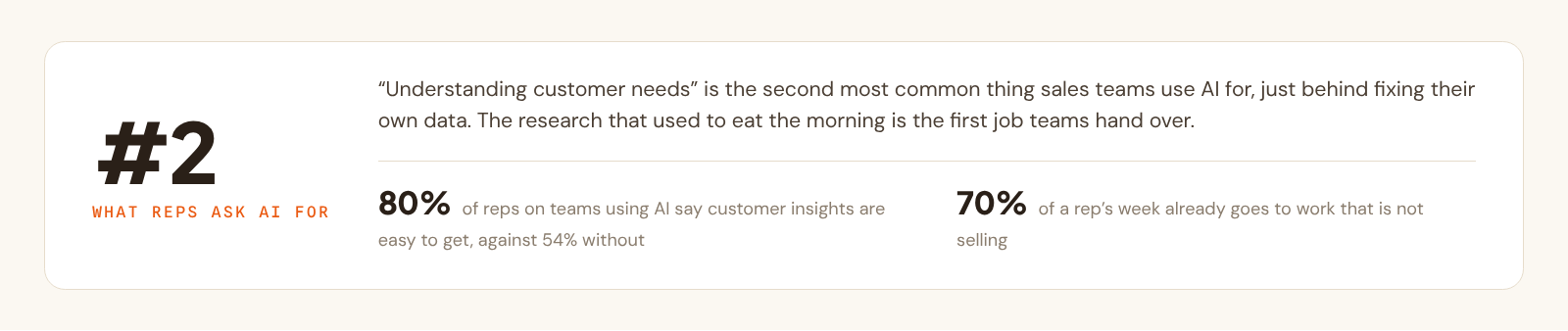
"Understanding customer needs" is the second most common thing sales teams now use AI for, just behind fixing their own data. Eighty percent of reps on teams using AI say customer insights are easy to get, against 54% on teams without. The research that used to eat the morning is the first job teams hand over.
Why it happens. Research is nobody's job and everybody's job. No step in the process says "brief the rep", so each person does it their own way, from scratch, every time — or skips it and trusts memory.
What it costs. Either the time, or the call. A call without a brief asks what the website already answers, misses the one thing the lead cares about, and ends with "send me something". Leads get scored on a hunch, so the best wait behind the loudest.
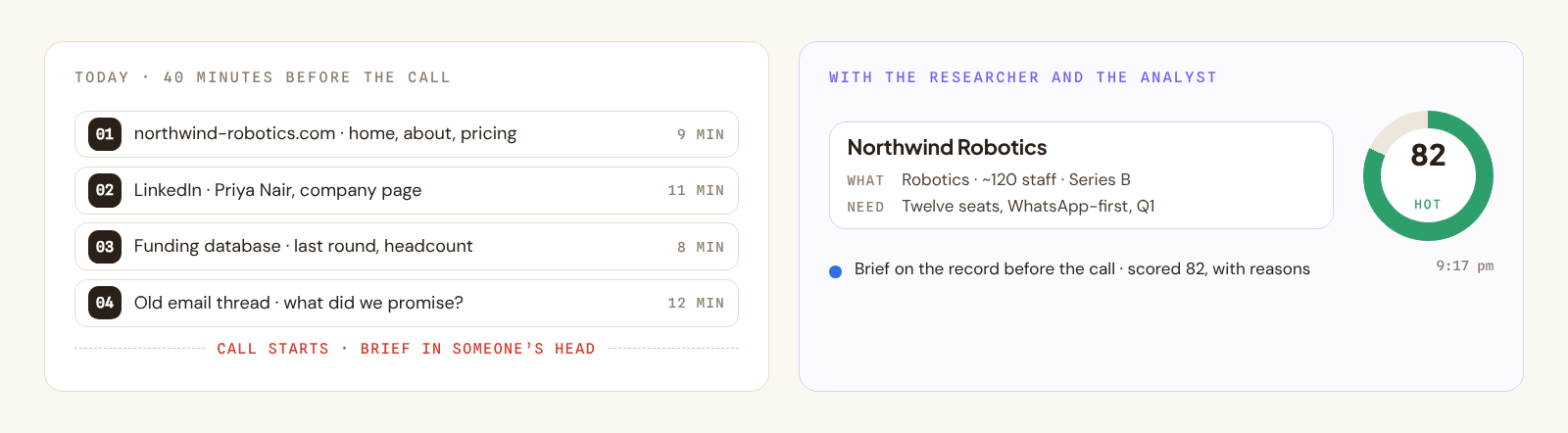
What closes it. A Researcher agent reads the company before you say hello and writes the brief on the record. An Analyst agent scores the lead against your ideal customer and your win history, with the reasons beside the number — so the best lead is always first in line.
The lead said "let me check with my partner and get back to you". Everyone meant to follow up. Nine days later nobody had, and the lead had quietly chosen someone else.
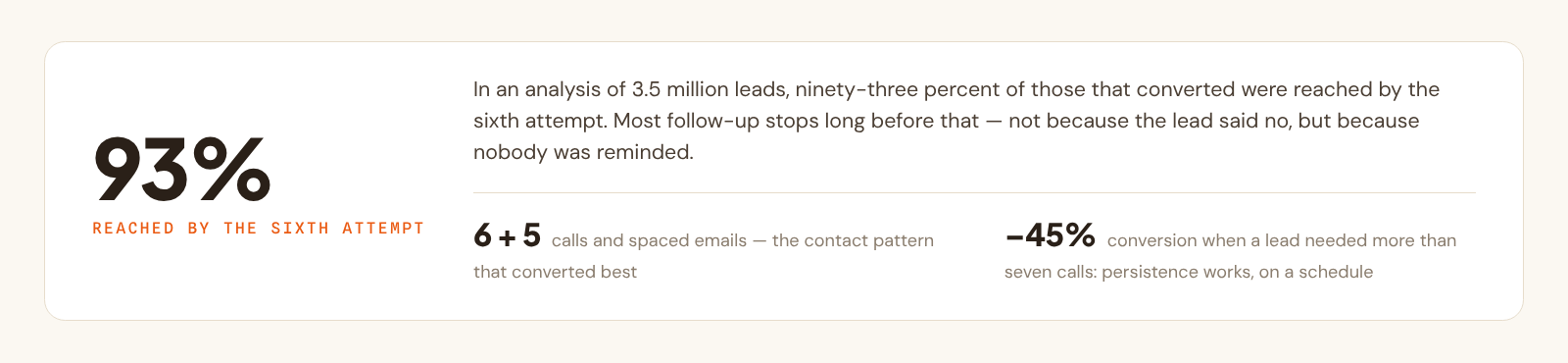
In an analysis of 3.5 million leads, ninety-three percent of those that converted were reached by the sixth contact attempt. The pattern that converted best was six calls and five spaced emails. Leads that needed more than seven calls were 45% less likely to convert — persistence works, but on a schedule. Most follow-up stops long before the sixth attempt. Not because the lead said no, but because nobody was reminded.
Why it happens. A follow-up lives in someone's head, a sticky note, or a task snoozed twice. The warm lead is polite, so there is no urgency; the new lead is loud, so it wins. And writing it takes effort — what do you say on day nine?
What it costs. These are the cheapest leads you will ever get: they know you, they asked, they had the first conversation. Losing them to silence means paying for a lead twice — once to get it, once to replace it.
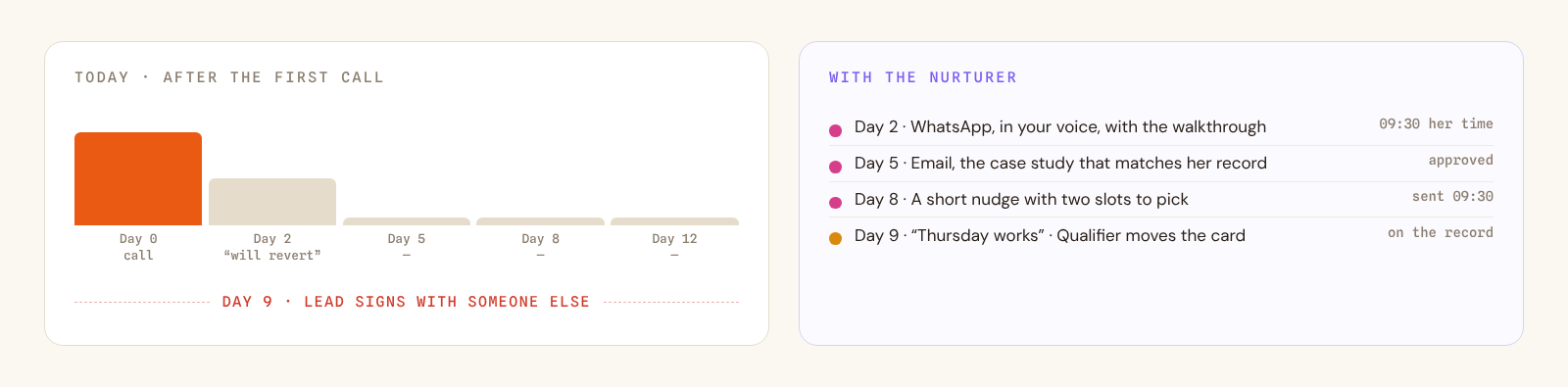
What closes it. A Nurturer agent reads the whole record, picks the next best touch and channel, writes it in your voice and sends it on time — every time, until the lead replies or asks to stop. When they answer, a Qualifier agent judges whether they are ready and moves the card, with the reason written down.
The demo went well. Three decisions and two promises came out of it. They live in a notebook and in one person's memory. The deal card still says "Demo scheduled".
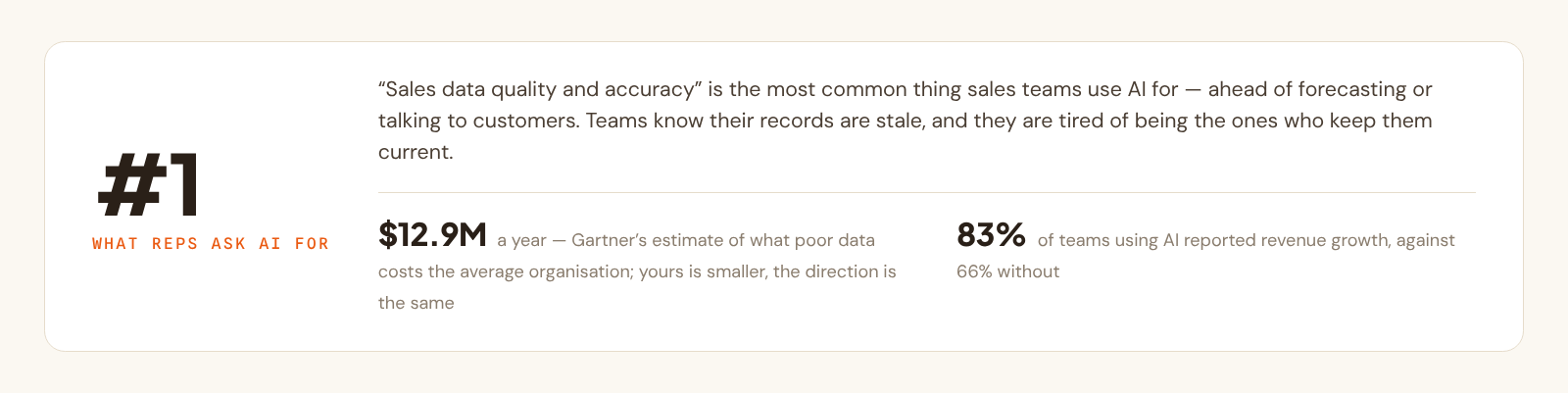
"Sales data quality and accuracy" is the single most common thing sales teams use AI for — ahead of forecasting or talking to customers. Teams know their records are stale, and they are tired of being the ones who keep them current. Gartner estimates poor data quality costs the average organisation $12.9 million a year; yours is smaller, but the direction is the same.
Why it happens. Writing up a meeting is the last thing on the list and the first thing dropped. The record gets updated when someone has to report on it; between reports it drifts — stages wrong, next steps missing, the score from the first call.
What it costs. Promises get missed because nobody wrote them down. Handovers restart from zero. Forecasts are built on cards nobody trusts. And everything downstream — scoring, follow-up, qualifying — works from a record a week behind the real conversation.
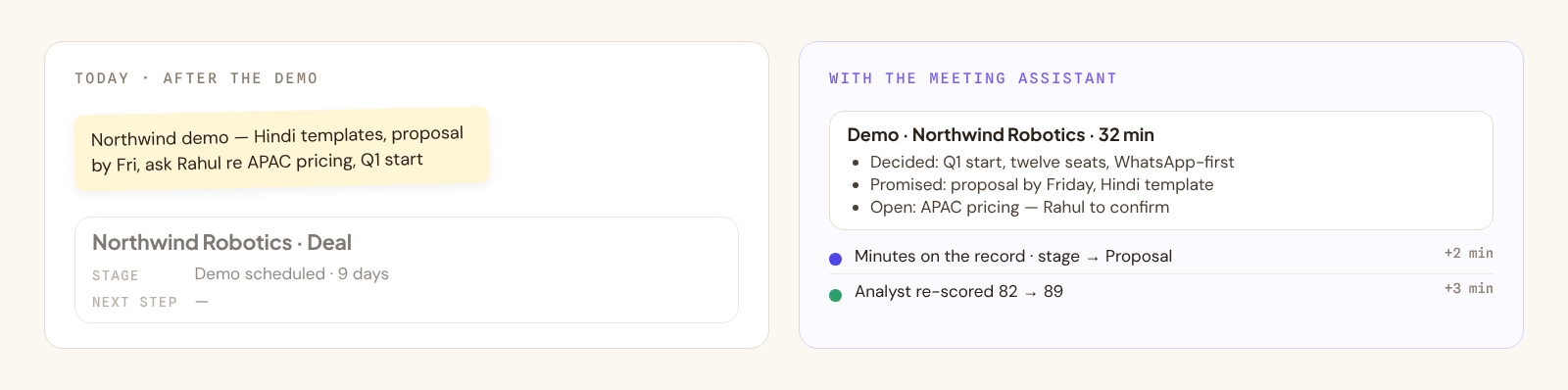
What closes it. A Meeting Assistant agent joins the meeting, transcribes it, and writes structured minutes — decisions, promises, open points — onto the record before anyone opens a notebook. The other agents act on the update, so the deal card is never behind the conversation.
Answer honestly for last week, not for how it is supposed to work. Count the number of "yes" answers.
Did any inbound inquiry wait more than an hour for a real reply? Include evenings, weekends, and the ones that came in on WhatsApp or as a comment.
Did outbound go out on fewer than three days last week? Or did a reply to an outbound message wait more than a day?
Did someone type a lead into a sheet or CRM by hand? Or find a lead that had never been typed in at all.
Did a first call start without a written brief on the company? Or did the brief take someone more than fifteen minutes to put together?
Is there a warm lead nobody has written to in more than a week? If you have to look it up, the answer is yes.
Is there a deal card whose stage or next step is out of date right now? Open your pipeline and check the three most valuable cards.
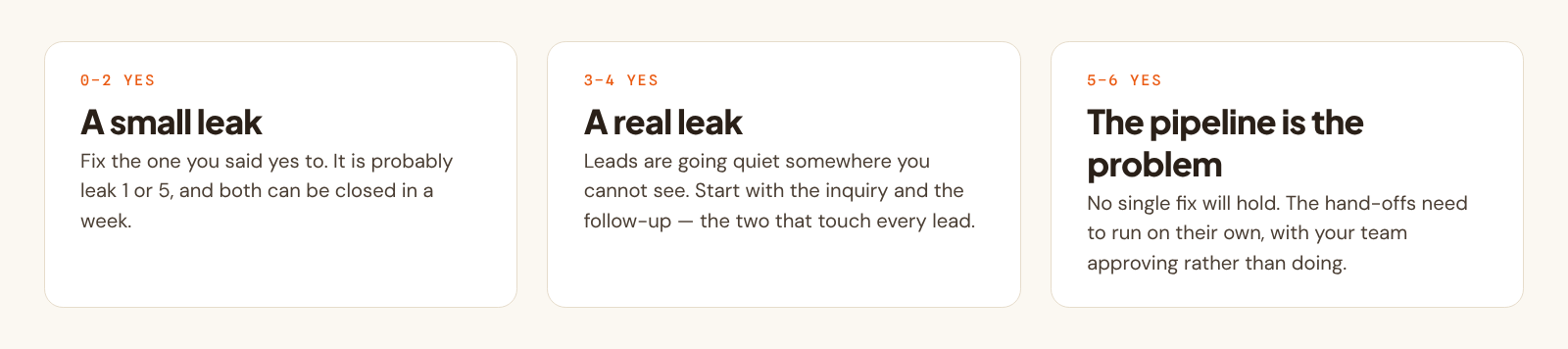
0–2 yes — a small leak. Fix the one you said yes to. It is probably leak 1 or 5, and both can be closed in a week.
3–4 yes — a real leak. Leads are going quiet somewhere you cannot see. Start with the inquiry and the follow-up — the two that touch every lead.
5–6 yes — the pipeline is the problem. No single fix will hold. The hand-offs need to run on their own, with your team approving rather than doing.
Every leak in this guide is a hand-off between people. Botmenia replaces the hand-offs, not the people: AI agents that answer inbound, run outbound, capture, research, score, follow up and write the minutes — all on one record, all visible to you.
Each agent starts in approve-first: it proposes, you approve, it learns. Switch any action to run on its own when you trust it, and switch it back any time. Everything an agent does is written on the record, so a person can always see why.
If you want to see it on your own leads, start free at botmenia.com — no card, your whole team included. Hire one agent for the leak you scored worst on, watch it work in approve-first for a week, and decide from there.
Prefer this as a PDF to share with your team? Comment and i'll share the link.
Sign in to respond and applaud.
No responses yet. Be the first.
 Artificial Intelligence
 IT Services & Consulting