
Lab-Grown vs Natural Diamonds: Which Is Better to Buy?
Lab-grown vs natural diamonds: compare price, quality, durability, origin, resale value and ethics to decide which diamond is better for you to buy
ErayaSparkle · SEO
Nov 5, 2026 · 6 min read
Lab-grown vs natural diamonds: compare price, quality, durability, origin, resale value and ethics to decide which diamond is better for you to buy
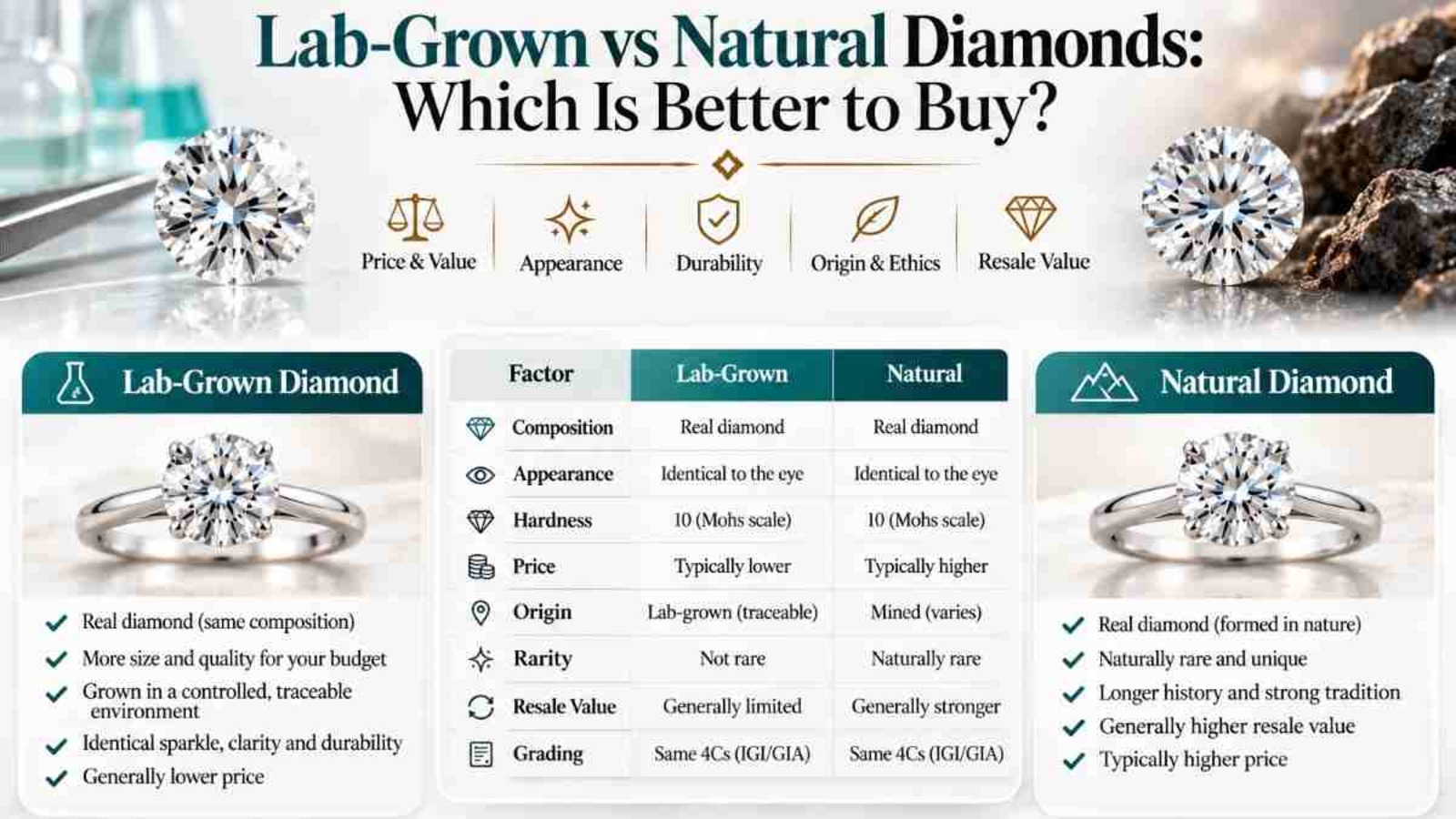

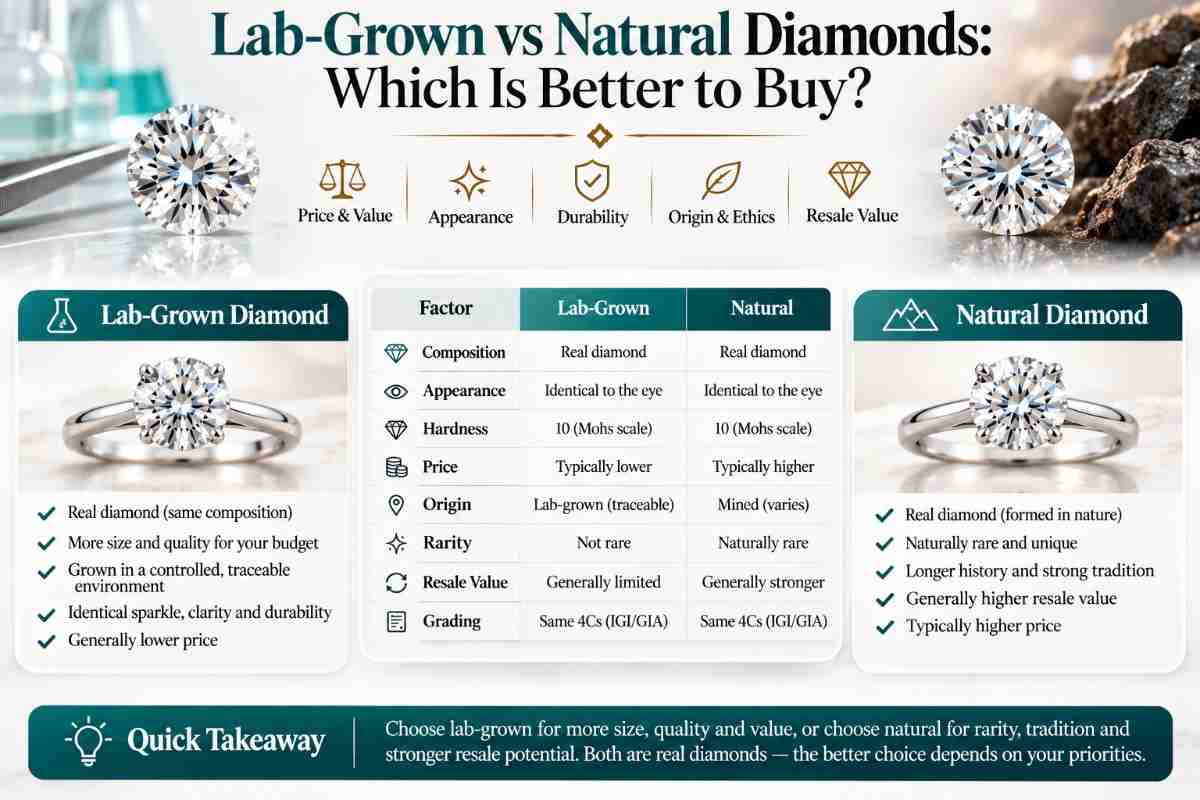
Few jewellery questions come up as often as this one: should I buy a lab-grown diamond or a natural one? Both are real diamonds, both sparkle, and both can make a beautiful ring or pair of earrings. The better choice depends on what matters most to you, whether that is budget, size, tradition, resale value, or origin.
This guide compares lab-grown vs natural diamonds fairly and clearly, so you can decide with confidence instead of guessing.
Neither is universally better. Lab-grown diamonds usually offer more size and quality for your money and a traceable origin. Natural diamonds offer rarity, tradition, and stronger long-term resale value. If you want the most diamond for your budget, lab-grown is often the better fit. If rarity and heritage matter most, natural may suit you better.
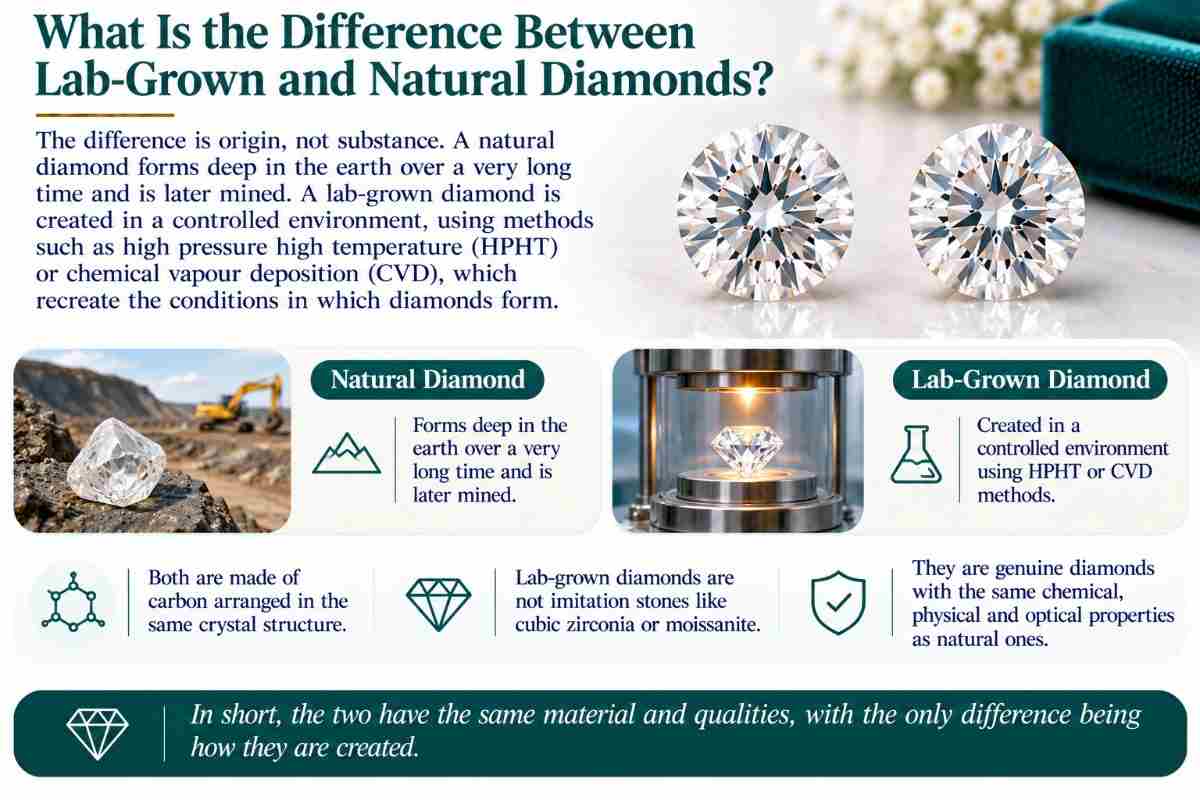
The difference is origin, not substance. A natural diamond forms deep in the earth over a very long time and is later mined. A lab-grown diamond is created in a controlled environment, using methods such as high-pressure, high-temperature (HPHT) or chemical vapour deposition (CVD), which recreate the conditions in which diamonds form.
Both are made of carbon arranged in the same crystal structure. Lab-grown diamonds are not imitation stones like cubic zirconia or moissanite. They are genuine diamonds with the same chemical, physical, and optical properties as natural ones.
Lab-Grown vs Natural Diamonds: Side-by-Side Comparison Factor
Lab-Grown Diamonds
Natural Diamonds
Composition
Real diamond (carbon crystal)
Real diamond (carbon crystal)
Appearance
Identical to the eye
Identical to the eye
Hardness
10 on the Mohs scale
10 on the Mohs scale
Price
Typically much lower for the same size and quality
Typically higher
Origin
Grown in a lab, easy to trace
Mined, traceability varies
Rarity
Not rare
Naturally rare
Resale value
Generally limited
Generally stronger, though not guaranteed
Grading
Graded on the same 4Cs by independent labs
Graded on the 4Cs by independent labs
Appearance and Quality
To the naked eye, and even under a jeweller's loupe, the two look the same. Telling them apart takes specialised equipment. Both are judged on the same four Cs: cut, colour, clarity and carat weight. A well-cut lab-grown diamond sparkles just as brilliantly as a natural one of the same grade.
Because lab-grown stones can be produced consistently, it is often easier to find high colour and clarity grades without a steep price premium.
Durability
Both types score 10 on the Mohs scale, the highest rating for hardness. That means both resist scratching and are well suited to everyday wear, including engagement rings worn daily. There is no durability advantage in either direction.
Price and Value
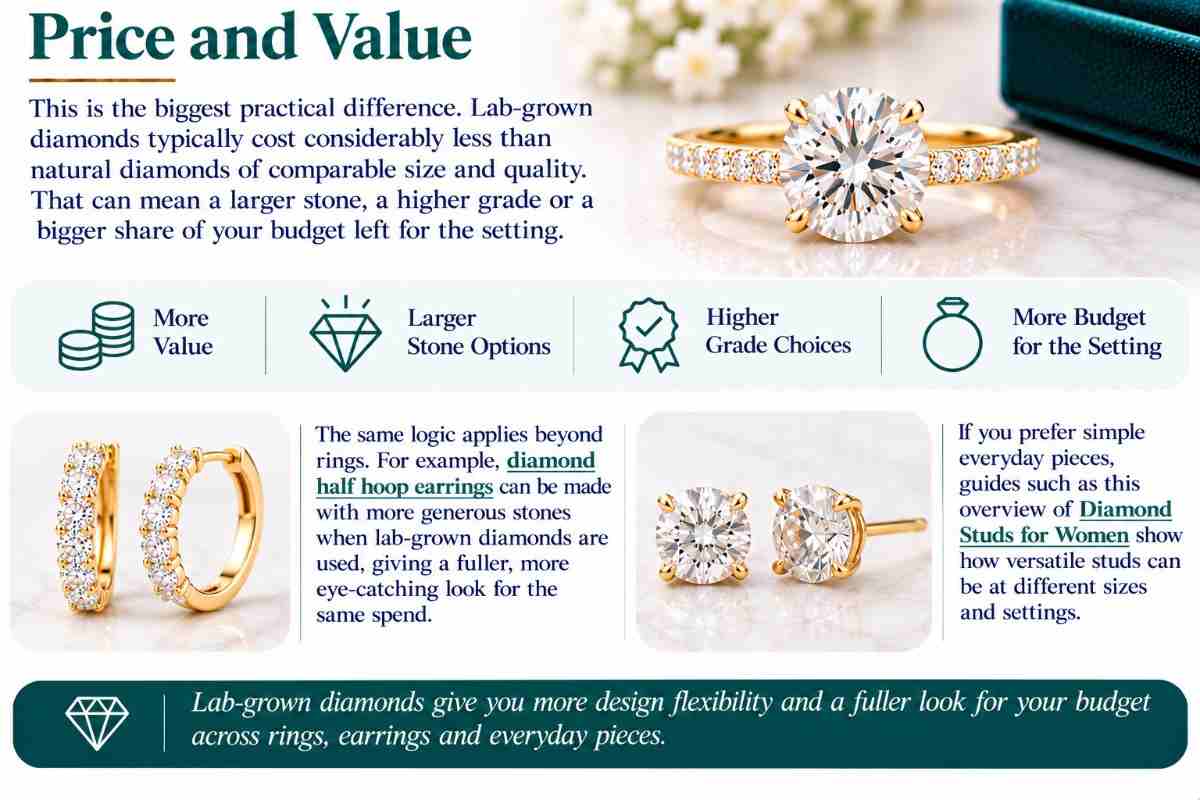
This is the biggest practical difference. Lab-grown diamonds typically cost considerably less than natural diamonds of comparable size and quality. That can mean a larger stone, a higher grade or a bigger share of your budget left for the setting.
The same logic applies beyond rings. For example, diamond half hoop earrings can be made with more generous stones when lab-grown diamonds are used, giving a fuller, more eye-catching look for the same spend. If you prefer simple everyday pieces, guides such as this overview of Diamond Studs for Women show how versatile studs can be at different sizes and settings.
Resale Value
It is worth being honest here. Natural diamonds generally hold resale value better, although they rarely sell for what you paid at retail. Lab-grown diamonds have a more limited resale market, and their prices have tended to fall as production has grown.
If you see your jewellery as something to wear and enjoy, rather than an investment, this matters less. If resale value is important to you, natural diamonds have the stronger track record.
Origin, Ethics and the Environment
Lab-grown diamonds offer clear traceability, since they are made in a known facility. Many buyers value that certainty. Natural diamonds can also be responsibly sourced, but their supply chains vary, so it helps to ask for sourcing information.
On the environment, the picture is not one-sided. Mining has a land and community impact, while growing diamonds uses a lot of energy, and its footprint depends on how that energy is generated. Neither choice is automatically "green," so look for transparent information from the seller.
Certification Matters for Both
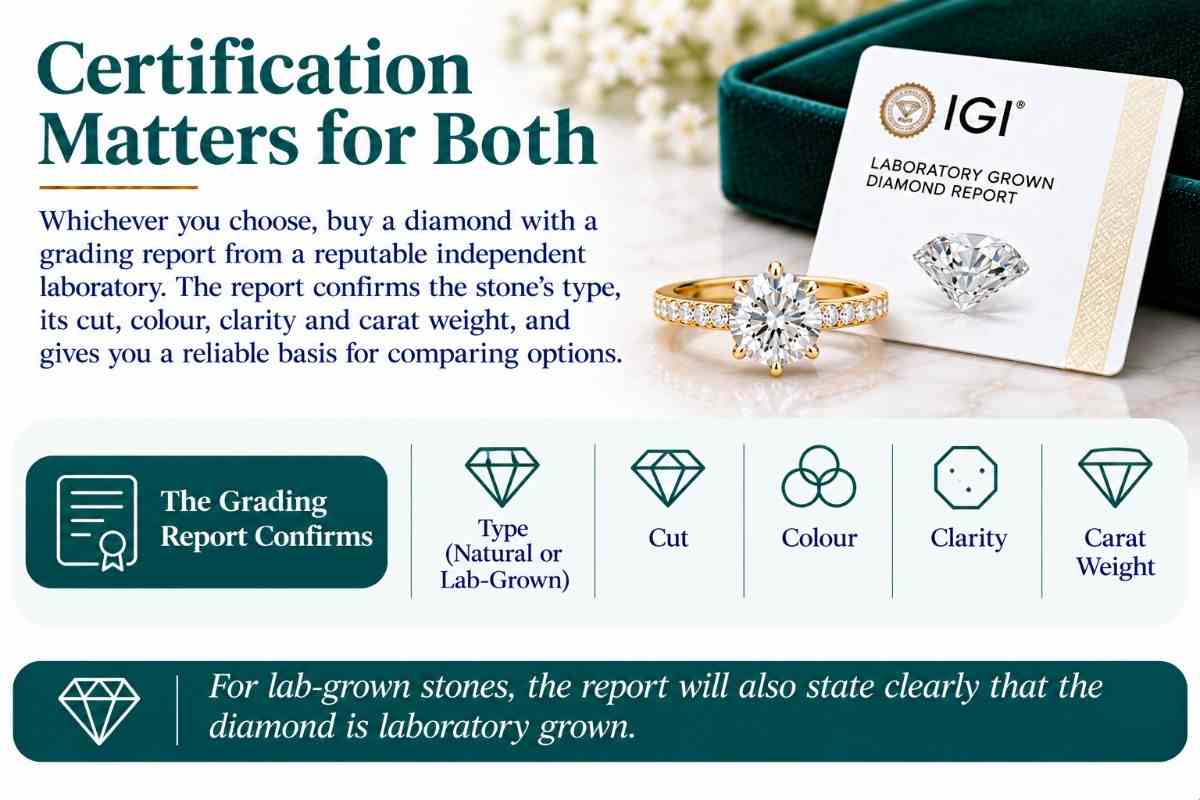
Whichever you choose, buy a diamond with a grading report from a reputable independent laboratory. The report confirms the stone's type, its cut, colour, clarity and carat weight, and gives you a reliable basis for comparing options. For lab-grown stones, the report will also state clearly that the diamond is laboratory grown.
Which Should You Choose?
Lab-grown may suit you if you:
Want a larger or higher-quality stone within your budget.
Value a transparent, traceable origin.
See your jewellery mainly as something to wear and enjoy.
Natural may suit you if you:
Value rarity and the tradition of a mined stone.
Care about long-term resale potential.
Are happy to pay a premium for natural origin.
Choosing a Ring
For engagement rings, the stone is the star, so the choice matters most here. If you love a clean, timeless design, you can buy solitaire rings in lab-grown diamonds and compare cuts, sizes and settings side by side. Put your budget toward cut quality first, because cut drives sparkle more than any other factor.
Common Myths
"Lab-grown diamonds are fake." They are real diamonds with the same composition and properties as natural ones.
"They look different." Even experts need special equipment to tell them apart.
"They are less durable." Both are 10 on the Mohs scale.
"Natural is always the better investment." Natural diamonds tend to retain more value, but jewellery is rarely a guaranteed investment.
Frequently Asked Questions
Are lab-grown diamonds real diamonds?
Ans. Yes. They have the same chemical composition, crystal structure and hardness as natural diamonds. They are made in a lab instead of being mined.
Can you tell the difference between lab-grown and natural diamonds?
Ans. Not by eye. Distinguishing them requires specialised laboratory equipment, which is why a grading report is important.
Is a lab-grown diamond cheaper than a natural diamond?
Ans. Generally yes. For the same size and quality, lab-grown diamonds usually cost considerably less.
Do lab-grown diamonds hold their value?
Ans. Their resale value is generally limited compared with natural diamonds. They are best chosen for wearing and enjoying rather than as an investment.
Which is better for an engagement ring?
Ans. It depends on your priorities. Lab-grown offers more size and quality per dollar, while natural offers rarity and stronger resale value.
The honest answer to lab-grown vs natural diamonds is that both are beautiful, both are real and both are durable. The better choice is the one that matches your priorities. If you want more sparkle and size for your budget and a traceable origin, lab-grown is a compelling option. If rarity, heritage and resale potential matter most, natural has the edge. Whichever you choose, insist on a reputable grading report, focus on cut quality and buy a piece you will love wearing.
Sign in to respond and applaud.
No responses yet. Be the first.