
How Irish Recruitment Agencies Read Your CV
CV Ireland IE · Ciara Roisin
Nov 3, 2026 · 5 min read
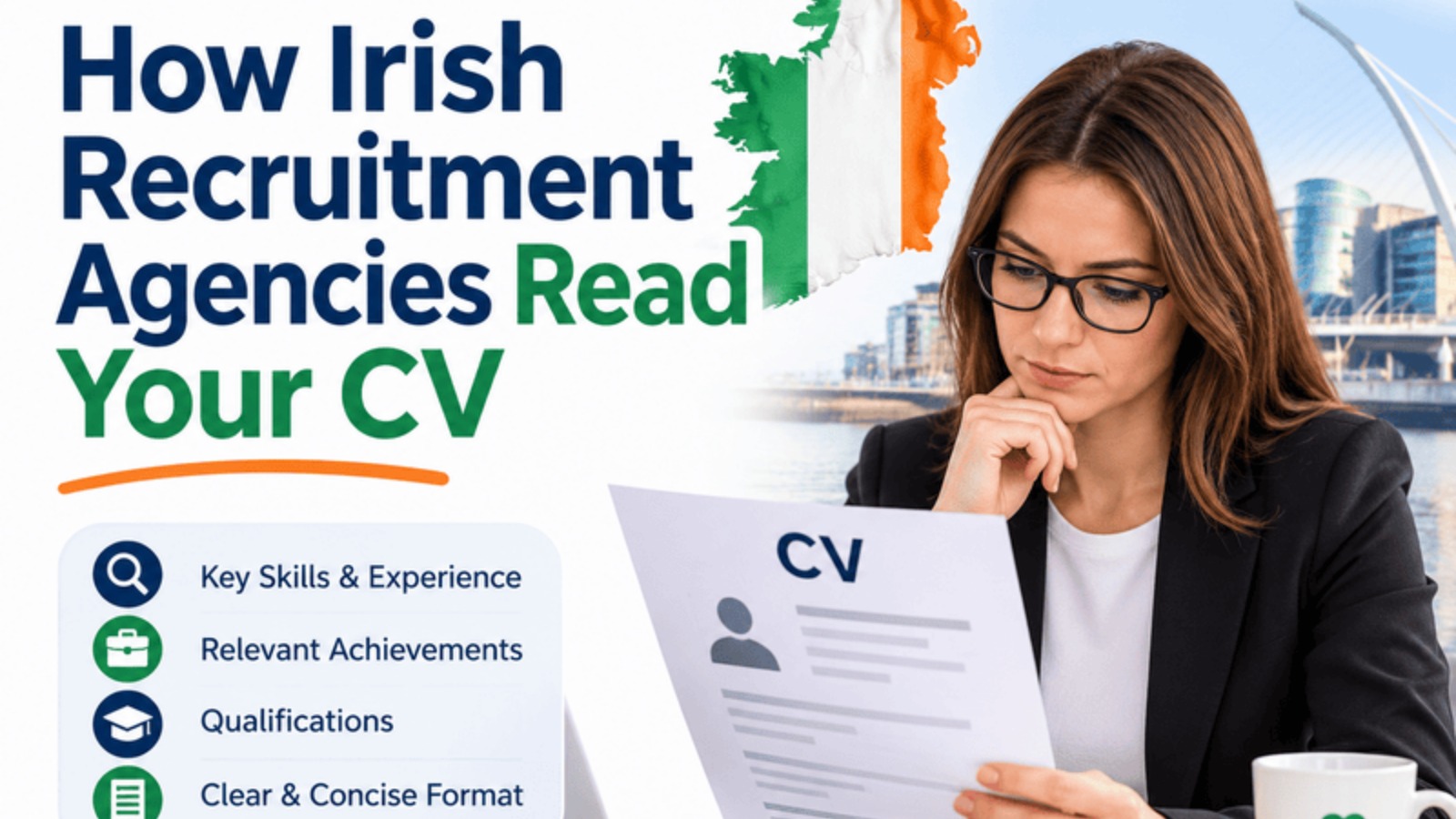

You spend hours polishing your CV, send it to a recruitment agency, and then wait. What happens next is rarely explained. In most cases, your CV is not read the way you imagine, from the first line to the last, by someone with plenty of time. It is scanned, searched and compared against other applicants, often within seconds.
Understanding that process gives you a real advantage. This guide explains how recruiters in Ireland typically review CVs, what they look for first, and how to structure yours so the right details are seen quickly.
Recruiters often handle many vacancies at once, and a single role can attract a large number of applications. The first read is therefore fast. They are not judging your whole career at this stage. They are asking one question: is this person worth a closer look for this job?
In that first scan, the eyes usually move to the same places: your name and location, your current or most recent job title, the employers you have worked for, and your dates. If those details match the role, the recruiter reads on. If they do not, the CV is often set aside, even when the candidate has strong skills that are buried further down the page.
This is why the top third of your first page matters so much. Put your target role, a short profile, and your most relevant recent experience where they are easy to find.
Many agencies do not only review CVs that arrive for a specific advert. They also upload them to a database, often called a CRM or applicant tracking system, and search it later when a new vacancy comes in. A recruiter might search for “financial controller”, “SAP”, “Dublin” and “ACCA” and then read only the CVs that appear.
That means your CV has a second life as a searchable document. To benefit from it:
Use standard job titles rather than invented ones. “Customer Success Manager” is searchable. “Client Happiness Hero” is not.
Include the tools, systems and qualifications that employers search for, such as software names, professional memberships and certifications.
Mention your location and work eligibility clearly, since recruiters filter by both.
Use plain formatting. Text boxes, tables, graphics and unusual fonts can confuse the software that reads the file.
If your CV passes the first scan, a recruiter looks at the shape of your career. They are checking for several things at once:
Progression. Have your responsibilities grown over time? Promotions, wider scope and larger teams suggest a candidate who develops.
Stability. Frequent, short roles can raise questions, although context matters. Contract work, redundancies and company closures are common, and a one-line explanation can remove doubt.
Relevance. Recent experience carries the most weight. A strong role from fifteen years ago matters less than a related one from last year.
Gaps. Career breaks are normal, and recruiters see them often. A brief, honest note, such as “career break for caring responsibilities” or “further study”, is far better than leaving an unexplained gap.
Your layout should make this story easy to follow. Use reverse chronological order, clear dates, and consistent formatting so a recruiter can follow your career in a few seconds.
Once recruiters are interested, they look for evidence. Lists of duties tell them little, because many people in similar roles share the same responsibilities. What separates candidates is what they achieved.
Compare these two bullet points:
“Responsible for managing client accounts.”
“Managed a portfolio of 35 client accounts, retaining 94 percent over two years and growing revenue by 18 percent.”
The second gives the recruiter something concrete to pass on to a hiring manager. Wherever you can, include numbers: revenue, savings, team size, targets met, projects delivered, or time saved. If you cannot share exact figures, approximate ones such as “a team of eight” or “over 200 customers a week” still help.
Many Irish employers, particularly in the public sector, healthcare, financial services and large multinationals, assess candidates against defined competencies such as leadership, communication, problem solving and delivering results. Application forms often ask for examples, and interviewers use structured questions to compare candidates fairly.
Recruiters know this, so they look for CVs that show these behaviours in action rather than simply claiming them. A line like “excellent communicator” proves nothing. A line that shows you presented a restructuring plan to a leadership team and secured sign-off proves a great deal.
If you find it hard to turn your experience into clear examples, a competency writing service can help you shape them into structured, evidence-based answers that fit both your CV and any application forms or interviews that follow.
At director and C-suite level, the review changes. Recruiters and search firms are not only checking skills. They are looking at scale, strategy and impact: the size of the budgets you managed, the teams you led, the businesses you grew or turned around, and the boards or stakeholders you worked with.
Senior CVs also need a different tone. They should read as a confident summary of leadership, with a strong executive profile, a clear record of results, and a short list of key achievements near the top. Because senior roles are often filled through discreet searches and personal networks, the document also has to work alongside your online profile and any biography you provide.
Many senior professionals find it hard to write about themselves objectively, which is why specialist executive resume writing services in dublin exist. They help leaders turn years of experience into a focused, results-led document that reads well to recruiters and boards alike.
Typos and inconsistent formatting. These suggest carelessness, especially for roles that demand accuracy.
A generic profile. Phrases such as “hard-working team player” appear on countless CVs and say nothing specific.
Too much length. Most Irish CVs run to two pages, with exceptions for senior or academic roles. Long documents bury the best information.
Missing contact details or location. If a recruiter cannot see where you are based or how to reach you, they will move on.
Unexplained job changes. A short note avoids unnecessary doubt.
Sending the same CV for every role. A tailored CV that mirrors the language of the advert is much easier to match.
A Quick Checklist Before You Send
Is your target role clear within the first few lines?
Do your job titles, employers and dates stand out?
Does each recent role include at least two or three measurable achievements?
Have you used the keywords and qualifications from the job advert, honestly?
Is the layout simple, with standard headings and no graphics or text boxes?
Have you checked spelling, dates and contact details twice?
Is your online profile consistent with your CV?
When to Get a Second Opinion
Because you know your own career so well, it is hard to see what a stranger would notice in a few seconds. A fresh pair of eyes can spot buried achievements, unclear job titles and layout problems you no longer see. If you want expert input, a professional CV Writing Service can restructure your document around what recruiters actually look for, and tailor it to the roles you want.
Final Thoughts
Recruitment agencies read CVs quickly, search them cleverly, and judge them by how easily they answer a simple question: is this the right person for this role? You cannot control how busy a recruiter is, but you can control how clear your CV is. Put the most relevant information first, prove your value with results, keep the formatting clean, and tailor the document to each role.
Do that consistently, and your CV will stop being a document that gets skimmed and start becoming one that gets shortlisted.
Sign in to respond and applaud.
No responses yet. Be the first.