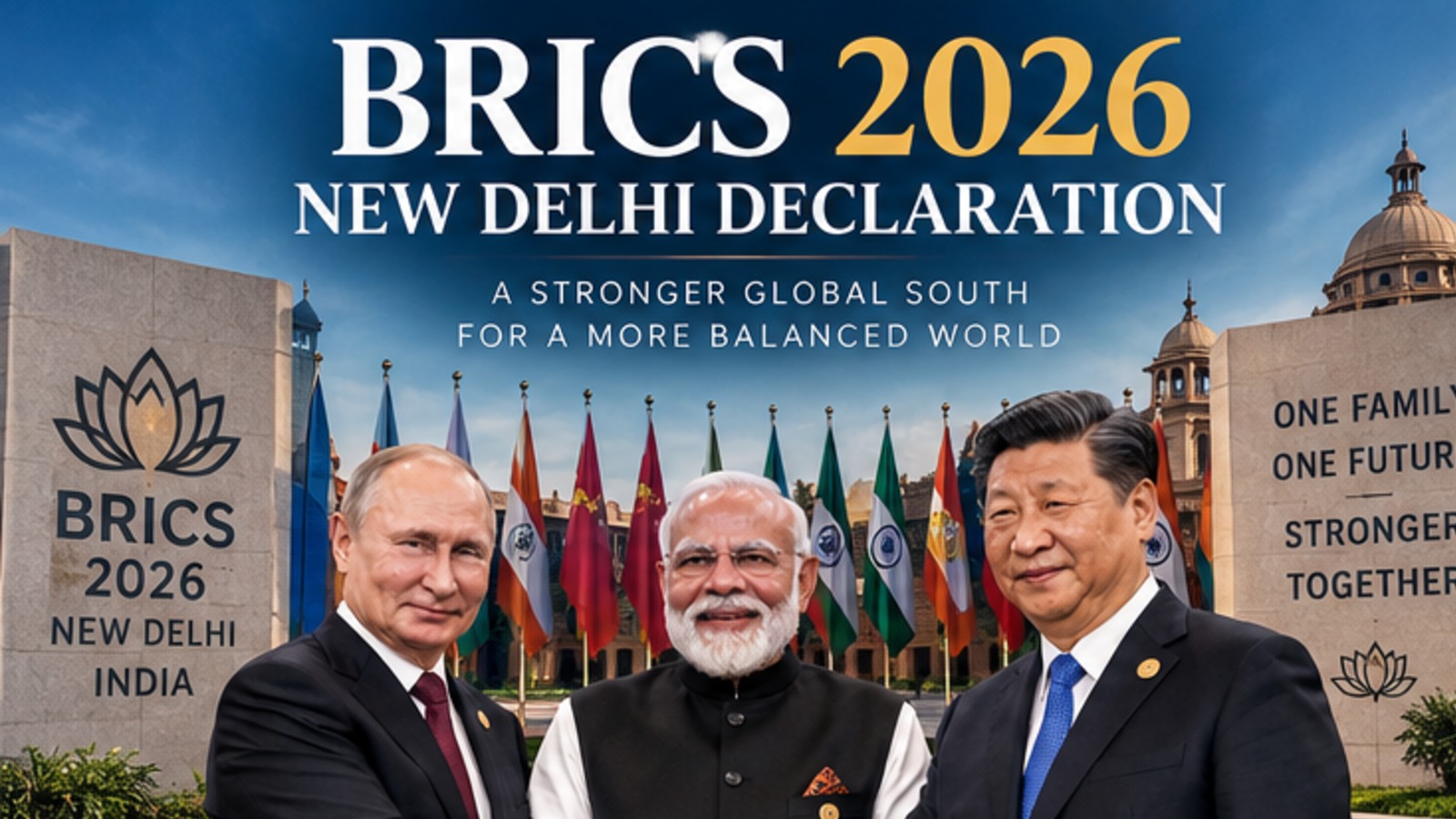
NEW DELHI, September 12, 2026: The 18th BRICS Summit in New Delhi has ended its first day with the adoption of the New Delhi Declaration 2026, a 140-point document that places global governance reform, the growing influence of the Global South, international security, trade, technology and sustainable development at the centre of the expanded grouping's agenda.
The declaration was adopted unanimously by the BRICS leaders meeting in New Delhi under India's 2026 chairship. The summit is particularly significant because BRICS is now a much larger grouping than the original Brazil-Russia-India-China-South Africa format, and its members include countries with sharply different foreign-policy interests.
The document therefore represents not simply a common position on global politics, but also an attempt to find areas of cooperation among countries that do not necessarily agree on every major international issue.
The declaration comes at a particularly turbulent moment in world affairs, with conflicts in the Middle East, the continuing war involving Ukraine, growing trade restrictions and tariffs, and renewed debate over the structure of the international financial and political system.
India's central message throughout the summit has been that BRICS should become a stronger voice for developing countries without turning itself into an anti-Western alliance.
A direct call to reform the UN Security Council
One of the most important sections of the declaration deals with reform of the international system.
BRICS members reiterated their support for comprehensive reform of the United Nations, including the UN Security Council, arguing that the institution needs to become more representative and better aligned with the realities of the contemporary world.
The declaration specifically calls for greater representation of developing countries from Africa, Asia and Latin America.
More importantly for India, Russia and China reiterated their support for the aspirations of Brazil and India to play a greater role in the United Nations, including the Security Council.
This is significant because India has long argued that the structure of the Security Council reflects the geopolitical realities of the mid-20th century rather than those of the 21st century.
The BRICS declaration also points out the historical under-representation of developing countries in senior positions within international organisations and calls for greater geographical and gender representation.
The broader message is clear: countries that now account for a much larger share of the world's population and economic activity want a greater role in setting global rules.
India gets support from Russia and China
For New Delhi, the reference to India's aspirations in the UN system is particularly important.
The declaration states that China and Russia, both permanent members of the Security Council, support the aspirations of India and Brazil to play a greater role in international affairs.
That does not, by itself, guarantee Security Council reform. Any actual restructuring of the Council would require a much wider international agreement.
But diplomatically, the language is important because it places India's demand inside a collective BRICS position rather than presenting it solely as an Indian request.
BRICS takes a hard line against unilateral sanctions and tariffs
The economic portion of the declaration contains another important message.
BRICS members criticised the growing use of unilateral tariffs and non-tariff measures, arguing that such policies can distort trade, disrupt global supply chains and increase uncertainty for developing economies.
The declaration also opposes unilateral economic sanctions and secondary sanctions that are not authorised by the UN Security Council.
The wording is particularly relevant because Russia and Iran are both under extensive Western sanctions, while the wider global economy has also been affected by increasing tariff barriers and trade restrictions.
Reuters reported that the declaration's criticism of unilateral trade measures came against the backdrop of US sanctions on Iran and Russia and growing tensions over global trade.
BRICS is therefore attempting to position itself as a defender of a rules-based multilateral trading system while simultaneously arguing that the rules themselves need reform.
The distinction matters.
The declaration does not call for the destruction of the existing international economic system. Instead, it calls for institutions such as the World Trade Organization, IMF and World Bank to become more representative of developing economies.
No new BRICS currency — but financial diversification continues
One issue that has attracted enormous attention in recent years is whether BRICS will create a common currency to challenge the US dollar.
The 2026 declaration does not announce the creation of a BRICS currency.
Instead, it focuses on strengthening existing financial mechanisms and expanding the role of the New Development Bank, including its ability to mobilise resources, diversify funding and expand local-currency financing.
This is an important distinction.
The political discussion around "de-dollarisation" has often been portrayed as an attempt by BRICS to replace the dollar. But the New Delhi Declaration is considerably more cautious.
Rather than announcing a common currency, it focuses on reducing vulnerabilities in financing and encouraging greater use of alternative financial mechanisms.
For India, this approach is particularly relevant because New Delhi has historically supported diversification of international financial arrangements while maintaining extensive economic relations with the United States and other Western economies.
The Middle East dominates the geopolitical section
The declaration comes as tensions in the Middle East have escalated sharply.
BRICS leaders expressed deep concern over the continued escalation of tensions in West Asia and called for maximum restraint.
They called for the protection of civilians and civilian infrastructure and urged countries to pursue dialogue and diplomacy rather than further escalation.
The declaration also stresses the importance of maintaining global trade, supply chains and energy flows.
That economic dimension is critical.
BRICS includes major energy producers as well as some of the world's largest energy consumers. Any prolonged conflict in the Middle East therefore has consequences not only for regional security but also for global oil markets, shipping routes, inflation and economic growth.
Reuters reported that reaching a consensus was particularly significant because the expanded BRICS grouping includes Iran as well as the United Arab Emirates, which maintains close relations with Washington.
The fact that countries with such different strategic relationships were able to agree on a common statement demonstrates both the diplomatic value of the BRICS platform and the limits of trying to turn it into a conventional military or political alliance.
Gaza and the Palestinian question
The declaration devotes considerable attention to Gaza and the Israeli-Palestinian conflict.
BRICS called for the implementation of relevant UN resolutions, continued humanitarian access and the maintenance of a ceasefire.
It also opposed forced displacement of Palestinians from Gaza and reaffirmed support for Palestinian membership in the United Nations.
The declaration again backed a two-state solution, with an independent Palestinian state based on the internationally recognised framework referenced in the document.
BRICS also expressed concern over attacks against civilian infrastructure and humanitarian facilities and stressed the need for compliance with international humanitarian law.
A strong condemnation of the Pahalgam terror attack
For India, perhaps the most politically significant language in the security section concerns terrorism.
The declaration condemns the April 22, 2025 terrorist attack in Jammu and Kashmir, in which 26 people were killed.
BRICS describes terrorism as criminal and unjustifiable regardless of its motivation and calls for zero tolerance toward terrorism.
It also specifically refers to cross-border movement of terrorists, terrorism financing and safe havens.
This language is important because India has consistently sought stronger international recognition of the cross-border dimension of terrorism.
The declaration also calls for the early adoption of a Comprehensive Convention on International Terrorism under the United Nations framework.
For New Delhi, bringing the Pahalgam attack into the BRICS declaration gives India a multilateral diplomatic platform to reinforce its longstanding position on terrorism.
BRICS does not become an anti-Western bloc
Perhaps the most important thing to understand about the New Delhi Declaration is what it does not say.
Despite criticism of unilateral sanctions, tariffs and Western-dominated institutions, BRICS has not transformed itself into a formal anti-American alliance.
India has been particularly careful on this point.
The declaration repeatedly talks about multilateralism, international law, dialogue, cooperation and reform rather than confrontation.
Indian Prime Minister Narendra Modi has also emphasised that BRICS should not be viewed as an anti-Western grouping.
This reflects a fundamental reality: BRICS members have vastly different relationships with the United States and Europe.
India has deepening strategic and economic ties with the West.
The UAE maintains a major partnership with Washington.
Brazil has traditionally pursued strategic autonomy.
Russia is in direct confrontation with the Western bloc.
Iran remains under severe Western pressure.
China is competing strategically with the United States.
A single anti-Western strategy would therefore be extremely difficult to sustain.
The New Delhi summit instead appears to have focused on an approach that is more useful to India: greater strategic autonomy without abandoning engagement with the existing international system.
Energy security becomes a major BRICS priority
Energy is another major area covered by the declaration.
BRICS members recognise energy security as fundamental to economic development and national security.
The document acknowledges that fossil fuels will continue to play an important role in the global energy mix, particularly for emerging markets and developing countries.
At the same time, it calls for an orderly, equitable and inclusive energy transition and for reductions in greenhouse-gas emissions.
The declaration also promotes cooperation in renewable energy, nuclear power, hydrogen, energy storage and other low-carbon technologies.
Critical minerals receive particular attention because they are increasingly important for batteries, electric vehicles, renewable energy systems, semiconductors and other advanced technologies.
This is an area where BRICS countries have considerable collective weight.
AI and technology enter the centre of BRICS strategy
The declaration also shows how quickly artificial intelligence has moved from being a technology issue to a geopolitical one.
BRICS leaders recognise AI as a major driver of economic growth and sustainable development.
But they also call for international cooperation on AI safety, security, accessibility, inclusiveness and reliability.
The document specifically highlights the importance of ensuring that developing countries have access to AI resources and that the benefits of the technology are not concentrated exclusively in advanced economies.
India's own leadership in AI diplomacy is reflected in the declaration's reference to the AI Impact Summit held in India in February 2026.
The broader objective is to ensure that the Global South is not merely a consumer of technologies developed elsewhere but participates in shaping the rules governing them.
Digital public infrastructure could become a major area of cooperation
One particularly interesting initiative is cooperation around digital public infrastructure.
The declaration proposes a BRICS repository for digital public infrastructure and pilot projects aimed at supporting digital transformation.
This is an area where India's experience with platforms such as digital identity, instant payments and other population-scale digital systems gives New Delhi a potentially influential role.
BRICS also discusses digital skills, cybersecurity, telecommunications and resilient digital infrastructure.
The declaration even refers to cooperation around submarine cable infrastructure connecting BRICS countries, recognising that digital connectivity is becoming as strategically important as physical trade routes.
Food security and a possible BRICS grain platform
Food security is another important component.
BRICS countries collectively include some of the world's major agricultural producers and consumers.
The declaration supports further work on a proposed BRICS Grain Exchange, which could eventually facilitate greater cooperation in agricultural commodities.
It also addresses fertilizer shortages, supply disruptions, agricultural resilience and climate-adaptive farming.
For developing economies, food price volatility can quickly become a political and economic crisis. BRICS is therefore increasingly treating food security as part of strategic resilience rather than simply agricultural policy.
The New Development Bank gets a larger role
The declaration also strengthens the importance of the New Development Bank, the multilateral development institution created by BRICS.
The leaders describe the bank as an increasingly important source of development and infrastructure financing for emerging and developing economies.
They call for the NDB to expand its ability to mobilise resources, diversify funding, support local-currency financing and fund sustainable infrastructure.
The declaration also supports further expansion of NDB membership.
This may ultimately be more consequential than the political rhetoric around a BRICS currency.
Building institutions capable of financing infrastructure in emerging markets gives BRICS a tangible mechanism through which it can increase its economic influence.
India tries to make BRICS more practical
India's presidency has emphasised a more practical and development-oriented BRICS.
According to the declaration, more than 400 meetings and engagements involving ministers, parliamentarians, officials, experts, businesses and civil society were held across 30 cities in India during the year.
The agenda has therefore extended well beyond summit diplomacy.
India has pushed cooperation on MSMEs, startups, technology, health, agriculture, digital infrastructure, disaster management, climate resilience, education, tourism and sports.
The declaration even notes the inaugural BRICS SME Forum in Agra, reflecting India's attempt to connect BRICS cooperation with domestic economic priorities.
What does the declaration actually change?
This is perhaps the most important question.
A summit declaration does not automatically create new international institutions or change the balance of power.
Much of the document consists of commitments, principles and calls for cooperation.
Its importance therefore lies partly in the direction it sets.
The New Delhi Declaration establishes several broad priorities:
First, BRICS wants greater representation for developing countries in global institutions.
Second, it wants the international economic system to become less vulnerable to unilateral tariffs and sanctions.
Third, it wants greater cooperation among emerging economies in energy, food, technology, finance and infrastructure.
Fourth, it wants BRICS to have a stronger voice on international conflicts without necessarily becoming a military or ideological bloc.
Fifth, it wants the Global South to have a greater role in setting the rules governing emerging technologies such as artificial intelligence.
The biggest challenge: BRICS is not a unified bloc
There is, however, a fundamental limitation.
BRICS is not the European Union, NATO or another institution with a common foreign policy.
Its members have competing national interests.
India and China remain strategic competitors.
Russia and the United States are adversaries.
Iran has a deeply confrontational relationship with Washington, while the UAE maintains strong Western partnerships.
Brazil's priorities are different from those of the Asian powers.
This makes consensus itself an achievement—but it also means that the strongest language in a declaration does not necessarily translate into coordinated action.
The New Delhi Declaration therefore needs to be judged not only by what its 140 paragraphs say, but by what BRICS countries actually implement over the next year.
India's diplomatic balancing act
For India, the summit represents a particularly delicate exercise in strategic balancing.
New Delhi is simultaneously deepening its engagement with the United States and other Western economies while maintaining longstanding relationships with Russia and expanding its engagement with Iran and the wider Global South.
At the same summit, Prime Minister Narendra Modi held talks with Chinese President Xi Jinping.
The two sides emphasised the need to prevent differences from becoming disputes and to maintain a long-term perspective on bilateral relations.
That development gives the summit an additional layer of significance.
India is attempting to demonstrate that it can work with China and Russia inside BRICS while simultaneously maintaining strategic partnerships with Western countries.
That is essentially the philosophy behind India's current multi-alignment strategy.
China takes over the BRICS chairmanship
The New Delhi Declaration concludes by handing the BRICS chairmanship to China for 2027, with China set to host the 19th BRICS Summit.
This creates an interesting transition.
India has spent 2026 trying to reinforce BRICS as a practical, development-focused platform.
China will now inherit the organisation at a time when debates over global governance, alternative financial systems, technology standards and the future of the international order are becoming increasingly intense.
The question will be whether China pushes BRICS more aggressively toward a China-Russia vision of a multipolar world—or whether the organisation continues along the more cautious, consensus-driven path that India promoted in New Delhi.
The larger geopolitical message
The real significance of the New Delhi Declaration is therefore not that BRICS has suddenly created an alternative world order.
It has not.
There is no BRICS military alliance.
There is no common BRICS currency.
There is no unified foreign policy.
And there is no single economic strategy shared by all members.
What is changing is something more gradual.
Countries representing a large part of the world's emerging economies are increasingly demanding a greater say in how international institutions work.
They want more representation in the UN Security Council.
They want greater voting power in global financial institutions.
They want alternatives to excessive dependence on financial systems controlled by a small number of countries.
They want developing countries to have a role in writing the rules for AI and other emerging technologies.
And they want international conflicts to be addressed through diplomacy rather than unilateral military or economic action.
That is the larger story emerging from New Delhi.
BRICS is not yet replacing the existing global order. It is trying to renegotiate its place within it.
And India's strategy appears to be clear: rather than choosing between the West and the emerging multipolar world, New Delhi wants to remain influential in both.